Sunday, June 19, 2011

Lavender Harvest

They say lavender has calming properties in addition to many other therapeutic uses. Harvesting lavender in and of itself was therapeutic. Deciding which buds to harvest, which to leave a little longer,  fingers scented from oils released from delicate wands, whorls of purple and blue in compact buds... it is an enjoyable, grounding activity.

As we have only a few plants, there won't be much to play with and make fun things like skin toner, lavender water, lavender pillows or sachets. This batch will be used for culinary purposes.


Saturday, June 18, 2011

Treasure Hunt

The benefit of having free range hens versus keeping them in a chicken run is probably obvious to most. Healthier chickens, more nutritious eggs, and fertilized pasture are the most obvious. There is a down side however, if you see it that way. For the past 3 days egg production has seemingly come to a halt, with only a couple of eggs each day in the usual places. The usual places are probably most unusual as we have let them pick their favorite nesting spot: some lay in the coop, some in the shed, and some in the garage.

Hidden Nest

The Hidden Entry

Blackberry Ensconced Quince
After combing the place several times and coming up empty, the local raven flock became suspect number one in the egg disappearance. No eggs in any of the nooks or crannies I could think of. This afternoon however, after watching "les girls" toddle off toward the tall grasses near the quince bush that has become ensnarled by blackberry vines, it dawned on me where the eggs had to be. Sure enough, a hidden cache of one dozen eggs lay in a nice little divot scratched out by the hens. On hands and knees, reaching deep into the brambles, my hand alighted on the very cool smooth surface of an egg.

Their choice of spots for a nest is impeccable. Not only is it completely invisible to the human (or raven) eye, the quince bush provides the element of refrigeration that has kept the eggs fresh until I could find them. I am thankful to have hens that can free range, carefully choose their nesting spots, and provide me with an entertaining Saturday afternoon treasure hunt.

Sunday, June 5, 2011

Honeybee Varroa Mite Inspection

The hive ladies got their very first powdered sugar dusting today. This technique is used to detect the presence of the veracious ferocious Varroa destructor, or varroa mite. The sugar knocks the mites off the backs of the bees and onto the bottom board. Removing and examining the bottom board gives a clue as to a hive's mite load.
Sugar Honeybees

Apparently these mites are omnipresent; all hives will eventually come up with them. It's early yet to expect to see many of them, but I'm pleased to report these ladies have come up with a clean bill of health. No detectable signs of mites!
Varroa mite hitching a ride on the back of a honeybee
Photo from Sciencedaily.com
The varroa mite parasite attaches itself to the honeybee and, like a leech, sucks on the bees hemolymph (blood). This weakens the bees and additionally makes them susceptible to viruses. It is thought that this mite is a key ingredient in Colony Collapse Disorder, the syndrome that is virtually killing off our bees.

How Much is Too Much Bee Business?

Yesterday our original, twice-swarmed hive saw a flurry of activity at the front of the hive. Bees landing on the front face, many bees hanging out at the entrance, bees seeming to not have a work agenda, like being heavily-laden with honey and coming in for a slow landing, or the pollen-legged type bringing flower protein to the colony. It looked as though there may be some robbing going on. There were even some bees much larger than I'm use to seeing coming and going. What is going on? My initial guess was that they were being robbed. And since our smallest weakest hive seemed to be experiencing the same activity lately and had around 15 or so dead bees on the landing, it seemed a plausible explanation.

Hive Covered With Wet Sheet
Launching into action, I swiftly reduced the entrance to the smallest possible size, and placed a wet sheet over the hive to deter any foreign subversive activity. Apparently the "home bees" are still able to find their way in while others are not. Within the hour crazy bee activity had ceased and the weather had turned back to normal Humboldt summer weather, cold and wet. So, I removed the sheet.

Was my assessment correct? There weren't dead bees all over and I couldn't really distinguish any fighting activity at the entrance. Was it just that we were experiencing a moment of nice weather for a change and even the drones decided they could come out for a quick look for those virgin queens some 60 feet above our heads? Such good weather that the activity was heavily increased from the norm? The big bees I saw, in retrospect were most likely our own drones since drones are probably not robbers...they're lovers, not fighters.

Oh the angst of an ignorant newbee keeper.

Life Before The Garden Cart?

I don't recall how I got much done before having a garden cart on hand to transport everything from bales of alfalfa to multiple bags of soil amendments to wine barrels. This barrel would have remained put under an imposing echium plant that was ensconcing it medusa-style. But Barbarella, our Barred Rock and Barney, our club-footed Rhode Islander were instrumental in the removal. They picked out all the bugs while I heave-hoed the soil and together we were able to remove much of the weight in the barrel before it was leveraged onto the cart for the transport. In this picture they are seen in their roles as transportation engineers.

Thursday, June 2, 2011

Migratory Hive Covers: WTF?

Hive inspection yesterday didn't go well. Besides the disappointment of finding queen cups in two hives, both hives with migratory covers were all damp inside, a condition not to the bee's liking. I suppose the ultimate meaning of migratory covers is that it will lead to your bees migrating away from your hive. Lovely. Where was the warning label for that? There are warning labels for everything else, even things more intuitive. You know, like the ones on silica packets (do not eat this) or on Alice in Wonderland's little bottles (Drink Me).

Migratory covers are for big-time beekeepers, which we are not. It enables them to stack their hives side to side for transportation to big-time orchards, which we do not do. Guess we're going to have to invest in more telescoping covers for our beautiful but damp, soggy, windy, cloudy, cold Humboldt summer.

Tuesday, May 31, 2011

Chicken-Proof Gardening And a Gardener/Beekeeper's Philosophical Rant

This weekend among the homestead projects was cleaning out half-barrels of spent brassica plants, reinvigorating the soil, and planting herbs in their place. The barrels are just off the deck, close to the kitchen, and a little handier than trucking  all the way out to the garden for a snippet or two of herbs.

Chicken-proof Herbs
After planting the barrels I took a break to sit on the deck and survey the results of our labor over the weekend when I looked down at the aspiring herb garden barrels to find that one of the Evil Stepsisters (translation: Wyandotte hen) was clawing contentedly away in the dirt at the location formerly occupied by two echinacea starts. Starts that took forever to germinate and grow to their current two inches high. Oh my! That will learn me to take a break before a job is complete. One echinacea was salvaged, the other was nowhere to be found, likely in the belly of the hen who will give it back to us in the form of an egg...a really nutritious egg.

It is interesting to note the change in gardening philosophy that keeping bees can bring. In my former gardening life, the spent brassicas wouldn't have been occupying precious barrel space. None-the-less there they were still, all gangly, twisting their long flowering stalks lazily atop the deck, effortlessly attracting entire tribes of aphids.  By all rights any self-respecting gardener would have yanked them up by their heads, tossed them to the compost, and made way for something new and more productive.


Enter the bee-minded gardener! Bees and brassicas apparently have coevolved. Bees need brassicas for the obvious nectar and pollen while brassicas need bees to assist in their pollination. They suffer from "self-incompatibility" (don't we all from time to time?): the pollen from one flower will only pollinate the flower of another brassica plant (no inbreeding here). This is a problem for them because their pollen is a bit on the sticky and heavy side and isn't readily windborne. Thus the bees and the brassicas enjoy a symbiotic relationship. Who am I to uproot half of a perfectly compatible partnership?

Monday, May 30, 2011

Oxymel: Honey as a Health Enhancement

Oxymel

Honey forecast for our hives post swarm(s): slim to none! So to celebrate, I made oxymel with another local beekeeper's honey. The Meyer lemon and the mint on-the-other-hand, are from the backyard. Next year if we're lucky (and add the second hive box in time), the oxymel will be made from  ingredients exclusively from the backyard!
Ingredients

Oxymel is an ancient Greek medicinal drink made of vinegar (the oxy portion) and honey (the mel portion). The ratio of honey to vinegar is 1:1 and you simply heat the honey at a low temperature in a stainless pot, add the vinegar, stir and let cool before transferring to a container. It will last indefinitely.

Hippocrates was said to have prescribed it for common colds as an expectorant, and as a general restorative. It's also been prescribed throughout time for other ailments such as: gout, sciatica, and pneumonia. Many cultures made similar concoctions, sometimes adding other healthful ingredients such as ginger, lemon, or mint.

Oxymel can be used by the spoonful as a medicine, or enjoyed in your tea or bubbly water for good health.

 "Let your food be your medicine" ~ Hippocrates

Saturday, May 28, 2011

Swarm Troopers

3 Hive Beeyard
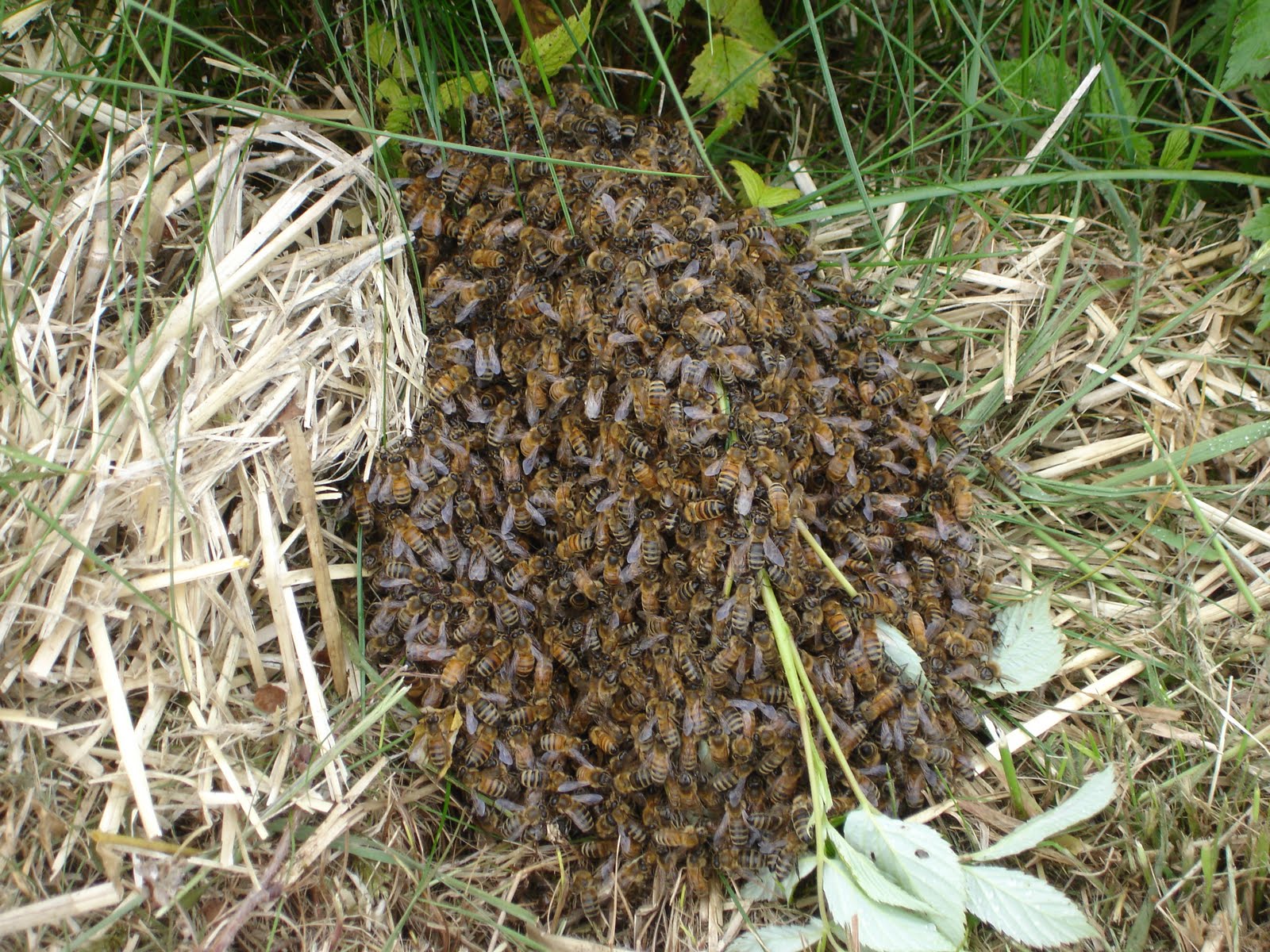
Here's what our beeyard looks like as of Monday. The great self-dividing hive has swarmed once again. Monday must be a good day for bees as that's the day our secondary swarm alighted in our garden atop  a few prickly new raspberry canes. Poor choice of "layover" spots as the raspberry cane promptly "laid over" on the ground from the weight of the small swarm, making it a little more challenging to remove.

Small Secondary Swarm on Raspberry Canes
With three hives now, two with non-productive virgin queens, weather this week is critical to these young ladies getting out and visiting the drone den in the sky to get a proper mating. Without a mated queen and left to their own devices, these hives will die out as only drones (males) can be laid from unfertilized eggs. The forecast so far...rain, rain, rain...but possibly some sun tomorrow. I can only hope our new queens will be mature enough to be ready for their mating flight by then. If by some time next week we still cant find these queens (we checked yesterday without success) or signs of her (newly laid eggs), timing will be critical to combine these hives back with the one with the good queen so that the worker bees don't start laying eggs, a newbee keeper's nightmare.


Swarm Capture
Swarm Trooper

I'm fascinated with the inner working of the colony. While bees are individual insects, collectively they act as one organism in that they are dependent upon each other for survival.  One lone bee in the world would catch it's death of cold very quickly without it's hive-mates to cluster together with, unhitch their wing muscles and vibrate them to create heat, as just one teeny tiny example. Now that I am confident in handling the hives sans gloves, my hands can feel the heat they generate as soon as I lift the inner cover. No wonder mice overwinter in hives.

I'm reading "Honeybee Democracy" by Thomas Seeley, Cornell University bee professor. The book delves into the way in which honeybees collectively and unanimously decide where their new home will be after they have swarmed. His many years of studying their behavior has valuable lessons for we humans in collective decision-making. It is amazing what these insects can teach us.

Saturday, May 21, 2011

Secondary Swarm Preparations Under Way

I took a long overdue bike ride to the Farmer's Market in Arcata this morning and when I returned there were a gazillion bees in the air flying about in probably a 75 foot radius, pretty big. My heart sank and I quickly realized me bees were swarming again. Needless to say, I'm not prepared and I didn't think this would really happen since I felt I was diligent in cutting out all but two queen cells from the hive. Within several minutes, they began condensing close to the hive and eventually landed on the south face of the hive in a huge cluster. This wasn't a swarm since they returned home, but it means they're preparing to leave again. How much excitement is too much excitement you ask?

Fortuitously, Marc assembled the hive his friend Rocky gave him last night so that he could start a hive at his house. It's not painted yet, but it will due in a pinch. Considering that, if we are lucky a second time to catch our own swarm when it leaves, we'd be phenomenally lucky if the three hives all end up "queen right", or with well-mated viable queens. More probable is that at least one hive will have no queen or an unmated queen and we'll have to recombine it in time with one of the two already established. That will at least give us a chance to paint the new hive and get it to Arcata. This is baptism by fire.

On a positive note, I went in and checked the new hive from the swarm on Monday and found the original queen with her little white dot. She has laid eggs on one side of one of the frames. There's not much comb built in there yet so she's probably waiting for the working girls to build more comb so she has a place to continuing with her motherly mission. Phew! Later today if the wind dies back I hope to inspect the original hive and see what in the world is going on in there. Crazy, huh?