Saturday, July 7, 2012
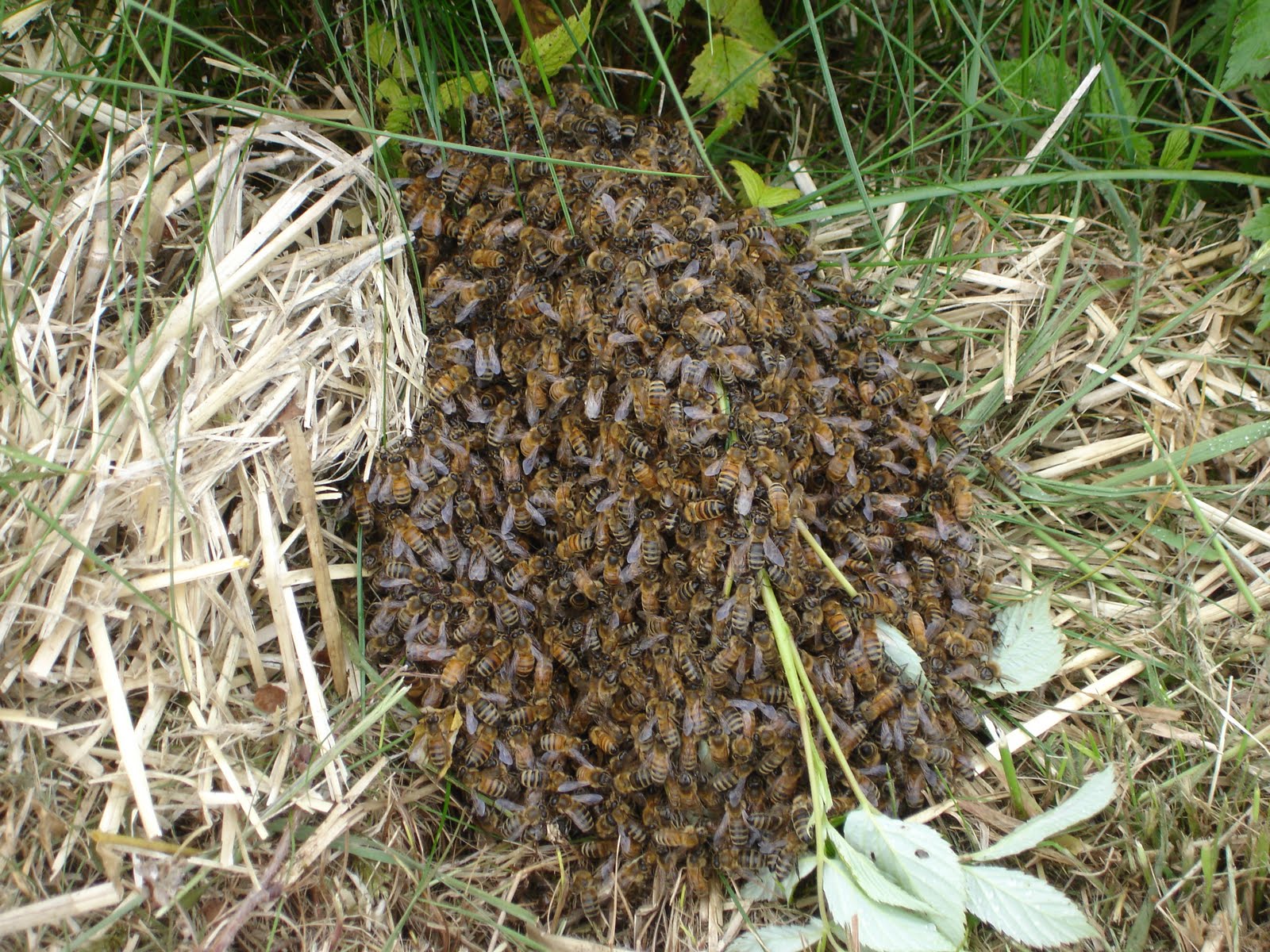
The Gift a Swarm
After a first attempt of relatively unsuccessful bee keeping and much internal debate wether or not to try again this year, a swarm landed in our garden. The packaged bees we purchased last year swarmed 3 times. In each swarm we failed to find a queen, inevitably leading to the demise of the hive. Also, leaving the only queen right hive too few in numbers not to have succumbed to the first frost. We were not alone. Success at keeping a hive over the winter was few and far between in the local bee circles e run in. Though those circles are small there still was not much to feel positive about where bee keeping is concerned. So the debate went, do we buy a $95 dollar package and give it another go, despite all of the potential roadblocks for the modern apiarist, or do i just wait for a swarm??? if we bite the bullet, spend the money, the worst case scenario is we pollinate the neighborhood, get a little honey and a few bee stings. Well, bee purchasing day at the university came and went. After that i only halfheartedly inquired about where i can locally purchase a package, the decision was made... i wait for a swarm... and a swarm did come... right into our lap... Actually, the top of the quince bush in our garden. it was truly a gift...
Tuesday, July 26, 2011
Bumble Bees Love Borage
| Pollen-legged Bumble Bee (upper right) |
I've been fortunate to be sitting here in front of the borage plant captured in a wine barrel and witness the daily comings and goings of several baby bumble bees. It's peeked my curiosity about the fuzzy little insect, apidae bombus a relative of the honeybees I' am tending nearby. Like the honeybee, they feed on pollen and nectar. And like the honeybee, they sting. I understand, and not from direct experience, that their stinger isn't barbed, so they have the distinct privilege of being able to sting over and over. They make their nests in holes in the ground...not the elaborate colony concocted by honeybees, they often only house 50 bees compared to the honeybees tens of thousands. But my favorite fun bumble bee fact is that they can "buzz pollinate", that is, the frequency of their buzz releases pollen from plants, in particular tomato plants. I'm pretty smitten with their genus "bombus" as well.
Wikipedia informs me that bumble bees visit the same plant day after day. So the bumble bees visiting today are the same ones I've been seeing every day. Thus the bumble bees and I have got a steady relationship forming. These pretty little creatures leave scents on the plants they visit that discourages competition from other bumble bee foragers. Guess I can safely name them now. This little tidbit makes me even more intent on continuing my ritual of shooing my canine companion from his nightly pursuit of capturing baby bumble bees in his ferocious jaws.
It is truly awesome the amazing natural world that is as close as the edge of the deck. To imagine that we are an integral part of it is all the more awe inspiring. If more of our kind spent more time sitting on the deck observing the coming and goings of the insects, plans and animals we share the world with, we'd have a better understanding of our place in nature and feel less compelled to continue to contribute to its ruination.
Sunday, July 3, 2011
Beautiful Broccoli, Entirely Homegrown Meal
Broccoli grows well in cool climates, hence it's a perfect crop for sometimes sunny, always cool, costal northern California. The broccoli bed was prepared with generous a helping of compost, another must.
Yesterday we harvested our first successful broccoli plant, yielding easily several pounds of broccoli. Last night's dinner was the result of the fruits of our labor: yukon gold potatoes with broccoli, and strawberry rhubarb cobbler.
The broccoli not only looked spectacular, it was the sweetest and most flavorful I've tasted. The stalks are firm but not woody and the left overs will make excellent broccoli cheddar soup today. We'll definitely purchase these seeds (Premium Crop Hybrid) again next year from Nichols Garden Nursery in Albany, Oregon. Although we've ventured into saving seeds from our crops, since this is a hybrid plants from the seed will likely have completely different qualities than the plants we're currently growing.
Yesterday we harvested our first successful broccoli plant, yielding easily several pounds of broccoli. Last night's dinner was the result of the fruits of our labor: yukon gold potatoes with broccoli, and strawberry rhubarb cobbler.
The broccoli not only looked spectacular, it was the sweetest and most flavorful I've tasted. The stalks are firm but not woody and the left overs will make excellent broccoli cheddar soup today. We'll definitely purchase these seeds (Premium Crop Hybrid) again next year from Nichols Garden Nursery in Albany, Oregon. Although we've ventured into saving seeds from our crops, since this is a hybrid plants from the seed will likely have completely different qualities than the plants we're currently growing.
Sunday, June 19, 2011
Lavender Harvest
They say lavender has calming properties in addition to many other therapeutic uses. Harvesting lavender in and of itself was therapeutic. Deciding which buds to harvest, which to leave a little longer, fingers scented from oils released from delicate wands, whorls of purple and blue in compact buds... it is an enjoyable, grounding activity.
As we have only a few plants, there won't be much to play with and make fun things like skin toner, lavender water, lavender pillows or sachets. This batch will be used for culinary purposes.
Saturday, June 18, 2011
Treasure Hunt
The benefit of having free range hens versus keeping them in a chicken run is probably obvious to most. Healthier chickens, more nutritious eggs, and fertilized pasture are the most obvious. There is a down side however, if you see it that way. For the past 3 days egg production has seemingly come to a halt, with only a couple of eggs each day in the usual places. The usual places are probably most unusual as we have let them pick their favorite nesting spot: some lay in the coop, some in the shed, and some in the garage.
After combing the place several times and coming up empty, the local raven flock became suspect number one in the egg disappearance. No eggs in any of the nooks or crannies I could think of. This afternoon however, after watching "les girls" toddle off toward the tall grasses near the quince bush that has become ensnarled by blackberry vines, it dawned on me where the eggs had to be. Sure enough, a hidden cache of one dozen eggs lay in a nice little divot scratched out by the hens. On hands and knees, reaching deep into the brambles, my hand alighted on the very cool smooth surface of an egg.
Their choice of spots for a nest is impeccable. Not only is it completely invisible to the human (or raven) eye, the quince bush provides the element of refrigeration that has kept the eggs fresh until I could find them. I am thankful to have hens that can free range, carefully choose their nesting spots, and provide me with an entertaining Saturday afternoon treasure hunt.
| Hidden Nest |
| The Hidden Entry |
| Blackberry Ensconced Quince |
Their choice of spots for a nest is impeccable. Not only is it completely invisible to the human (or raven) eye, the quince bush provides the element of refrigeration that has kept the eggs fresh until I could find them. I am thankful to have hens that can free range, carefully choose their nesting spots, and provide me with an entertaining Saturday afternoon treasure hunt.
Sunday, June 5, 2011
Honeybee Varroa Mite Inspection
The hive ladies got their very first powdered sugar dusting today. This technique is used to detect the presence of the veracious ferocious Varroa destructor, or varroa mite. The sugar knocks the mites off the backs of the bees and onto the bottom board. Removing and examining the bottom board gives a clue as to a hive's mite load.
Apparently these mites are omnipresent; all hives will eventually come up with them. It's early yet to expect to see many of them, but I'm pleased to report these ladies have come up with a clean bill of health. No detectable signs of mites!
The varroa mite parasite attaches itself to the honeybee and, like a leech, sucks on the bees hemolymph (blood). This weakens the bees and additionally makes them susceptible to viruses. It is thought that this mite is a key ingredient in Colony Collapse Disorder, the syndrome that is virtually killing off our bees.
| Sugar Honeybees |
Apparently these mites are omnipresent; all hives will eventually come up with them. It's early yet to expect to see many of them, but I'm pleased to report these ladies have come up with a clean bill of health. No detectable signs of mites!
![]() |
| Varroa mite hitching a ride on the back of a honeybee Photo from Sciencedaily.com |
How Much is Too Much Bee Business?
Yesterday our original, twice-swarmed hive saw a flurry of activity at the front of the hive. Bees landing on the front face, many bees hanging out at the entrance, bees seeming to not have a work agenda, like being heavily-laden with honey and coming in for a slow landing, or the pollen-legged type bringing flower protein to the colony. It looked as though there may be some robbing going on. There were even some bees much larger than I'm use to seeing coming and going. What is going on? My initial guess was that they were being robbed. And since our smallest weakest hive seemed to be experiencing the same activity lately and had around 15 or so dead bees on the landing, it seemed a plausible explanation.
Launching into action, I swiftly reduced the entrance to the smallest possible size, and placed a wet sheet over the hive to deter any foreign subversive activity. Apparently the "home bees" are still able to find their way in while others are not. Within the hour crazy bee activity had ceased and the weather had turned back to normal Humboldt summer weather, cold and wet. So, I removed the sheet.
Was my assessment correct? There weren't dead bees all over and I couldn't really distinguish any fighting activity at the entrance. Was it just that we were experiencing a moment of nice weather for a change and even the drones decided they could come out for a quick look for those virgin queens some 60 feet above our heads? Such good weather that the activity was heavily increased from the norm? The big bees I saw, in retrospect were most likely our own drones since drones are probably not robbers...they're lovers, not fighters.
Oh the angst of an ignorant newbee keeper.
| Hive Covered With Wet Sheet |
Was my assessment correct? There weren't dead bees all over and I couldn't really distinguish any fighting activity at the entrance. Was it just that we were experiencing a moment of nice weather for a change and even the drones decided they could come out for a quick look for those virgin queens some 60 feet above our heads? Such good weather that the activity was heavily increased from the norm? The big bees I saw, in retrospect were most likely our own drones since drones are probably not robbers...they're lovers, not fighters.
Oh the angst of an ignorant newbee keeper.
Life Before The Garden Cart?
Thursday, June 2, 2011
Migratory Hive Covers: WTF?
Hive inspection yesterday didn't go well. Besides the disappointment of finding queen cups in two hives, both hives with migratory covers were all damp inside, a condition not to the bee's liking. I suppose the ultimate meaning of migratory covers is that it will lead to your bees migrating away from your hive. Lovely. Where was the warning label for that? There are warning labels for everything else, even things more intuitive. You know, like the ones on silica packets (do not eat this) or on Alice in Wonderland's little bottles (Drink Me).
Migratory covers are for big-time beekeepers, which we are not. It enables them to stack their hives side to side for transportation to big-time orchards, which we do not do. Guess we're going to have to invest in more telescoping covers for our beautiful but damp, soggy, windy, cloudy, cold Humboldt summer.
Tuesday, May 31, 2011
Chicken-Proof Gardening And a Gardener/Beekeeper's Philosophical Rant
This weekend among the homestead projects was cleaning out half-barrels of spent brassica plants, reinvigorating the soil, and planting herbs in their place. The barrels are just off the deck, close to the kitchen, and a little handier than trucking all the way out to the garden for a snippet or two of herbs.
After planting the barrels I took a break to sit on the deck and survey the results of our labor over the weekend when I looked down at the aspiring herb garden barrels to find that one of the Evil Stepsisters (translation: Wyandotte hen) was clawing contentedly away in the dirt at the location formerly occupied by two echinacea starts. Starts that took forever to germinate and grow to their current two inches high. Oh my! That will learn me to take a break before a job is complete. One echinacea was salvaged, the other was nowhere to be found, likely in the belly of the hen who will give it back to us in the form of an egg...a really nutritious egg.
It is interesting to note the change in gardening philosophy that keeping bees can bring. In my former gardening life, the spent brassicas wouldn't have been occupying precious barrel space. None-the-less there they were still, all gangly, twisting their long flowering stalks lazily atop the deck, effortlessly attracting entire tribes of aphids. By all rights any self-respecting gardener would have yanked them up by their heads, tossed them to the compost, and made way for something new and more productive.
Enter the bee-minded gardener! Bees and brassicas apparently have coevolved. Bees need brassicas for the obvious nectar and pollen while brassicas need bees to assist in their pollination. They suffer from "self-incompatibility" (don't we all from time to time?): the pollen from one flower will only pollinate the flower of another brassica plant (no inbreeding here). This is a problem for them because their pollen is a bit on the sticky and heavy side and isn't readily windborne. Thus the bees and the brassicas enjoy a symbiotic relationship. Who am I to uproot half of a perfectly compatible partnership?
| Chicken-proof Herbs |
It is interesting to note the change in gardening philosophy that keeping bees can bring. In my former gardening life, the spent brassicas wouldn't have been occupying precious barrel space. None-the-less there they were still, all gangly, twisting their long flowering stalks lazily atop the deck, effortlessly attracting entire tribes of aphids. By all rights any self-respecting gardener would have yanked them up by their heads, tossed them to the compost, and made way for something new and more productive.
Enter the bee-minded gardener! Bees and brassicas apparently have coevolved. Bees need brassicas for the obvious nectar and pollen while brassicas need bees to assist in their pollination. They suffer from "self-incompatibility" (don't we all from time to time?): the pollen from one flower will only pollinate the flower of another brassica plant (no inbreeding here). This is a problem for them because their pollen is a bit on the sticky and heavy side and isn't readily windborne. Thus the bees and the brassicas enjoy a symbiotic relationship. Who am I to uproot half of a perfectly compatible partnership?
Monday, May 30, 2011
Oxymel: Honey as a Health Enhancement
![]() |
| Oxymel |
Honey forecast for our hives post swarm(s): slim to none! So to celebrate, I made oxymel with another local beekeeper's honey. The Meyer lemon and the mint on-the-other-hand, are from the backyard. Next year if we're lucky (and add the second hive box in time), the oxymel will be made from ingredients exclusively from the backyard!
![]() |
| Ingredients |
Oxymel is an ancient Greek medicinal drink made of vinegar (the oxy portion) and honey (the mel portion). The ratio of honey to vinegar is 1:1 and you simply heat the honey at a low temperature in a stainless pot, add the vinegar, stir and let cool before transferring to a container. It will last indefinitely.
Hippocrates was said to have prescribed it for common colds as an expectorant, and as a general restorative. It's also been prescribed throughout time for other ailments such as: gout, sciatica, and pneumonia. Many cultures made similar concoctions, sometimes adding other healthful ingredients such as ginger, lemon, or mint.
Oxymel can be used by the spoonful as a medicine, or enjoyed in your tea or bubbly water for good health.
"Let your food be your medicine" ~ Hippocrates
Saturday, May 28, 2011
Swarm Troopers
| 3 Hive Beeyard |
| Small Secondary Swarm on Raspberry Canes |
| Swarm Capture |
| Swarm Trooper |
I'm fascinated with the inner working of the colony. While bees are individual insects, collectively they act as one organism in that they are dependent upon each other for survival. One lone bee in the world would catch it's death of cold very quickly without it's hive-mates to cluster together with, unhitch their wing muscles and vibrate them to create heat, as just one teeny tiny example. Now that I am confident in handling the hives sans gloves, my hands can feel the heat they generate as soon as I lift the inner cover. No wonder mice overwinter in hives.
I'm reading "Honeybee Democracy" by Thomas Seeley, Cornell University bee professor. The book delves into the way in which honeybees collectively and unanimously decide where their new home will be after they have swarmed. His many years of studying their behavior has valuable lessons for we humans in collective decision-making. It is amazing what these insects can teach us.
Saturday, May 21, 2011
Secondary Swarm Preparations Under Way
I took a long overdue bike ride to the Farmer's Market in Arcata this morning and when I returned there were a gazillion bees in the air flying about in probably a 75 foot radius, pretty big. My heart sank and I quickly realized me bees were swarming again. Needless to say, I'm not prepared and I didn't think this would really happen since I felt I was diligent in cutting out all but two queen cells from the hive. Within several minutes, they began condensing close to the hive and eventually landed on the south face of the hive in a huge cluster. This wasn't a swarm since they returned home, but it means they're preparing to leave again. How much excitement is too much excitement you ask?
Fortuitously, Marc assembled the hive his friend Rocky gave him last night so that he could start a hive at his house. It's not painted yet, but it will due in a pinch. Considering that, if we are lucky a second time to catch our own swarm when it leaves, we'd be phenomenally lucky if the three hives all end up "queen right", or with well-mated viable queens. More probable is that at least one hive will have no queen or an unmated queen and we'll have to recombine it in time with one of the two already established. That will at least give us a chance to paint the new hive and get it to Arcata. This is baptism by fire.
On a positive note, I went in and checked the new hive from the swarm on Monday and found the original queen with her little white dot. She has laid eggs on one side of one of the frames. There's not much comb built in there yet so she's probably waiting for the working girls to build more comb so she has a place to continuing with her motherly mission. Phew! Later today if the wind dies back I hope to inspect the original hive and see what in the world is going on in there. Crazy, huh?
Fortuitously, Marc assembled the hive his friend Rocky gave him last night so that he could start a hive at his house. It's not painted yet, but it will due in a pinch. Considering that, if we are lucky a second time to catch our own swarm when it leaves, we'd be phenomenally lucky if the three hives all end up "queen right", or with well-mated viable queens. More probable is that at least one hive will have no queen or an unmated queen and we'll have to recombine it in time with one of the two already established. That will at least give us a chance to paint the new hive and get it to Arcata. This is baptism by fire.
On a positive note, I went in and checked the new hive from the swarm on Monday and found the original queen with her little white dot. She has laid eggs on one side of one of the frames. There's not much comb built in there yet so she's probably waiting for the working girls to build more comb so she has a place to continuing with her motherly mission. Phew! Later today if the wind dies back I hope to inspect the original hive and see what in the world is going on in there. Crazy, huh?
Thursday, May 19, 2011
The Almost Queen
Today was almost good enough to get in to check the old hive to see how many queen cells we've left for them. Too many increases the chances that they will again swarm, a so-called "after swarm". We'd like to keep two in case one doesn't make it, it gives the hive a second chance to have their own home-made queen (rather than a bought queen). On Monday just after the swarm we checked and thought there were two, possibly three queen cells at the most. They contained larvae but they were not yet capped over with wax to pupate.
"Almost" good enough weather was going to have to be good enough weather to check in on them as I was nervous as to just how many queens are pupating in there. Sure enough, the uppermost hive body contained three queen cells all on the center frame (the one that I had moved upstairs from the first box when I put the second one on two Saturdays ago). The lower box had one queen cell that I hadn't seen on Monday. How are these peanut shaped things that hang low from the bottom of the frame so elusive? I cut out the one cell in the bottom hive, and one from the upper, leaving two queen cells. The ladies will have to battle it out, or the one that hatches first will likely open the cell of her competitor and sting her to death. A kind of royal "off with her head" execution. Only she does it herself instead of directing minions to do the dirty deed as you might expect of royalty. Because we forgot to take a photo of the queen cells we left, we went back in sans smoke to get a pic. Apparently we're not doing a great job of getting bees out of the way as there were not two, but three capped queen cells hanging there. Glad we forgot the picture as it gave us the opportunity to once again narrow the field for the royal competition soon to come.
The picture below is that of one of the queen cells that we opened after we cut it out. What a beautiful perfectly formed bee is this "almost queen". Sad we had to take her out, so to speak. As perfectly formed as she is, she was probably about 14 or 15 days old; only a day or two away from hatching. We can probably expect that, if we're going to have another swarm, it's going to be very soon.
"Almost" good enough weather was going to have to be good enough weather to check in on them as I was nervous as to just how many queens are pupating in there. Sure enough, the uppermost hive body contained three queen cells all on the center frame (the one that I had moved upstairs from the first box when I put the second one on two Saturdays ago). The lower box had one queen cell that I hadn't seen on Monday. How are these peanut shaped things that hang low from the bottom of the frame so elusive? I cut out the one cell in the bottom hive, and one from the upper, leaving two queen cells. The ladies will have to battle it out, or the one that hatches first will likely open the cell of her competitor and sting her to death. A kind of royal "off with her head" execution. Only she does it herself instead of directing minions to do the dirty deed as you might expect of royalty. Because we forgot to take a photo of the queen cells we left, we went back in sans smoke to get a pic. Apparently we're not doing a great job of getting bees out of the way as there were not two, but three capped queen cells hanging there. Glad we forgot the picture as it gave us the opportunity to once again narrow the field for the royal competition soon to come.
| Two Queen Cells Covered in Bees |
The picture below is that of one of the queen cells that we opened after we cut it out. What a beautiful perfectly formed bee is this "almost queen". Sad we had to take her out, so to speak. As perfectly formed as she is, she was probably about 14 or 15 days old; only a day or two away from hatching. We can probably expect that, if we're going to have another swarm, it's going to be very soon.
| She Will Never Get To Compete For the Crown |
Tuesday, May 17, 2011
The Day After ~ Orientation Day
The bee yard is abuzz with lots of winged ladies taking orienting flights just outside the new hive. They're do this to learn where their new home is so that they can begin to go out and forage for nectar and pollen and find their way home. Since their original home is right next door I wonder if they're experiencing deja vu. Only problem...they're also conducting these flights in front of the old hive too. My best guess is that the bees from the swarm are drifting over to their old hive. If were lucky, really lucky, we'll end up with enough bees in each hive to continue their important work of feeding babies and storing food. I'm feeling lucky and don't expect to find a queen all alone in the new hive...those queen pheromones are simply irresistable.
This picture was taken yesterday when we noticed, in the midst of the excitement of swarm chasing, that a garden spider was feasting on one of our bees. It took a moment to reflect on nature's delicately balanced food chain and not take it personally that a spider was lunching on one of our bees. As the circle of life has it, that bee will nourish that spider that will in turn do wonderful things for that sunflower in our garden. That sunflower will give us visual pleasure for a time and in turn provide the goats succulent sustenance, and maybe leave a few seeds for the chickens if they're lucky!
The cycles of life are self-evident in our little yard lately. Saturday we trimmed a holly tree that was casting shade on the garden only to learn that it contained a bird's nest with new born babies in it. Sadly they didn't survive the trauma even after we perched the reconstructed nest in the crotch of the same tree. Ravens quickly found and decimated what remained. Later that day we found a very much alive nest of baby birds in our chicken shed. One nest of baby birds perishes, another will live. And so it goes...
| Spider Eating Bee (Hint: Double-click for a close up) |
The cycles of life are self-evident in our little yard lately. Saturday we trimmed a holly tree that was casting shade on the garden only to learn that it contained a bird's nest with new born babies in it. Sadly they didn't survive the trauma even after we perched the reconstructed nest in the crotch of the same tree. Ravens quickly found and decimated what remained. Later that day we found a very much alive nest of baby birds in our chicken shed. One nest of baby birds perishes, another will live. And so it goes...
Monday, May 16, 2011
SWARM!!!
Beekeeping is not for the faint of heart. It isn't an exact science and knowing what they bees are up to and then how you'd like to handle it can keep you up nights.
Friday's hive inspection netted 5 or more queen cells hanging from one of the brood frames in the top hive box, a sign of either swarm preparation or supercedure. Most likely I waited a little too long to give them more brood space by giving them a second box to lay eggs and store honey and pollen. So the signs of swarm were there Friday. To try to prevent a swarm I squished all the queen cells, even though it felt odd squishing the larva of the little insects I've been trying so hard not to squish every time I enter their little "queendom". But today they swarmed anyway and landed in a holly tree near the goat shed. Nice and low and easy to cut out, box up, and walk over to a newly set up hive. Good fortune!
| Swarm in our holly tree |
I was glad to have heard over and over in bee class that swarming bees are gentle bees. That greatly increased my comfort level of handling them. The discomfort comes with the myriad questions about the old hive and the new. Are the hives too close and the swarm bees will migrate back in the old box or allow bees left to tend the old hive to drift to the new? Are there enough bees in the old hive to keep the brood warm and fed? Do I have a virgin queen in the old hive or do I need to order a new one? If I do have a queen in the making, do I let nature take its course even though odds are much less favorable for the viability of the new queen your hive will make than one you buy already mated? It's enough to make you lose an otherwise cozy night's sleep.
A quick check of the original hive showed no signs of a queen cell that was chewed through that would indicate there is a new queen on the loose in the hive. There were however, either two or three queen cups with larvae in them hanging at the bottom of the same frames with the original queen cells last week. If I'm sure there's no queen I can order a new one and have a greatly elevated chance of having a good queen for this hive. If there's one in there already the hive likely won't accept the new bought queen even thought she's their best bet. Finding a baby unmarked queen in there is probably much more than my unseasoned bee vision can be relied on to see.
Sunday, May 8, 2011
Goats in the Chicken Coop
Who would have guessed that we crafted a chicken coop more appealing to goats than chickens. Most likely the climb onto a bale of hay and concrete block in order to access the chicken-sized coop opening appeals to the very basic nature of these climbers. Being the dwarves that they are, they happen also to fit very nicely through the tiny door. We've spent the first several days with the new kids kicking them out of the coop. To divert their attention, we've constructed a goat playground from bales of hay, a garden cart and a couple of saw horses and plywood left over from constructing the goat shed. Lots of running and jumping and kicking and twisting from atop the plywood platform. They can balance on their two front feet better than any trapeze artist I know. OK well yes, I don't know any, but if I did...
One lovely bonus is their love of the blackberry infested overgrown quince bush. They like succulent new blackberry shoots and leaves over almost anything you can forage for them. They like dandelion leaves over flowers. They like chicken scratch over ANYTHING!
Since chicken feed has too much calcium for goats we thought better of allowing them to gorge themselves on it. Geniuses that we think we are, we hid the chicken food under the coop where there was room only for small fowl. Wrong again... these two darlings got down on their knees in order to shimmy underneath to dine with the flock. Bottom line, goats are intelligent creatures who can easily outwit their unwitting new family.
One lovely bonus is their love of the blackberry infested overgrown quince bush. They like succulent new blackberry shoots and leaves over almost anything you can forage for them. They like dandelion leaves over flowers. They like chicken scratch over ANYTHING!
Since chicken feed has too much calcium for goats we thought better of allowing them to gorge themselves on it. Geniuses that we think we are, we hid the chicken food under the coop where there was room only for small fowl. Wrong again... these two darlings got down on their knees in order to shimmy underneath to dine with the flock. Bottom line, goats are intelligent creatures who can easily outwit their unwitting new family.
Sunday, April 10, 2011
Goodbye to Google Ad Sense
I'm not really into advertising for other people on my silly little blog that probably only my parents are interested in visiting more than once. So the final straw in my decision to remove "Ad Sense" from the right-hand side of this blog came when the ad appeared this evening for "a career in chicken de-beaking via an on-line degree". Of all the crazy things that are probable, I"m sure a degree in chicken debeaking is not one. Even if by some long long stretch of the imagination it were, I don't want to be the one to encourage anyone toward such a cruel career. Good-bye Ad Sense. My good sense says it's time you go.
The Bees Have Arrived
It's been a bizzzy day here. The bees finally arrived. We picked them up early afternoon and got a live demonstration of installation. Garrett, our class instructor, made it look easy. Fortunately the weather predictions for rain didn't come to fruition and we were able to put them in the easy way rather than the rainy day method.
When the time finally came to shake in our own bees to their new hive home, after months of anticipation, excitement became colored with just a little tinge of nerves. Gathering everything together and popping the feeder can from the package uncorked and released the nerves; it was time to get to work. As odd as it was to get comfortable with bees crawling all over me, particularly exposed hands, the only jerking reaction came when one found its way onto the small of my back. Oops, no bending over without full beekeeper regalia I suppose.
After shaking the package for what felt like a long time, and closing up the hive with only a couple of squished bees (sorry ladies), the package with the reming bees was put directly in front of the hive to find their way in. After an hour there were still way too many bees in the package all clumped up. When what to my wondering eyes should appear but a queen that they were huddled around. We removed her and a few attendants and put an ad for her on Humboldt Beekeeper's Yahoo Group. Dan came on up to get her and, lo and behold, she was a he...a drone. He said it was pretty early to have a drone, but more possible as they came from the valley where it's been warmer. Heck, what do I know. Hopefully what a real queen looks like. After he left I zoomed back to the Yahoo Group and hit "delete" to remove any trace of my complete and utter ignorance.
It was so windy this afternoon that the bees left in the package outside the hive got chilled and stopped moving around. Being the overly emotional people we are about animals, and apparently now insects too, we brought them in to the house, warmed them up by the fire, re-placed them in front of the hive after they started buzzing around once again. I hope they find their way to their new home. So, OMG, I have to open up that box again in four days to see if the worker bees have chewed their way through the queen cage to free their royal highness. I think I can do this...
| Bee Loading Instructions in Bayside |
| Sideways Beekeeper |
| Two Bees Doing the "Come Into the Hive Over Here " Dance at the Opening |
When the time finally came to shake in our own bees to their new hive home, after months of anticipation, excitement became colored with just a little tinge of nerves. Gathering everything together and popping the feeder can from the package uncorked and released the nerves; it was time to get to work. As odd as it was to get comfortable with bees crawling all over me, particularly exposed hands, the only jerking reaction came when one found its way onto the small of my back. Oops, no bending over without full beekeeper regalia I suppose.
After shaking the package for what felt like a long time, and closing up the hive with only a couple of squished bees (sorry ladies), the package with the reming bees was put directly in front of the hive to find their way in. After an hour there were still way too many bees in the package all clumped up. When what to my wondering eyes should appear but a queen that they were huddled around. We removed her and a few attendants and put an ad for her on Humboldt Beekeeper's Yahoo Group. Dan came on up to get her and, lo and behold, she was a he...a drone. He said it was pretty early to have a drone, but more possible as they came from the valley where it's been warmer. Heck, what do I know. Hopefully what a real queen looks like. After he left I zoomed back to the Yahoo Group and hit "delete" to remove any trace of my complete and utter ignorance.
![]() |
| Never Confuse Your Drone with Your Queen - Keep This Chart Handy! |
It was so windy this afternoon that the bees left in the package outside the hive got chilled and stopped moving around. Being the overly emotional people we are about animals, and apparently now insects too, we brought them in to the house, warmed them up by the fire, re-placed them in front of the hive after they started buzzing around once again. I hope they find their way to their new home. So, OMG, I have to open up that box again in four days to see if the worker bees have chewed their way through the queen cage to free their royal highness. I think I can do this...
Wednesday, March 30, 2011
The Chicken Killing Cone
This week we got a package in the mail. It was one that we ordered. Did we really? Yes, indeed we did. I can't believe I ordered this thing on Amazon and actually shelled out the money for it. It's not that it was that expensive, it's just the nature of the item, more specifically, what it is used for. You see, we have intent. Our intent is to raise chickens for egg production, nitrogenous chicken poop, and down the line...for consumption after their laying life has waned.
But how does one reconcile intent with action? In this case, our intent to provide for ourselves and live a sustainable lifestyle runs smack up against a belief that all life is deserving of respect. In other words, I don't' think I am there yet...there being the act of using this killing cone. I know I know...we homo sapiens (puts us more on an animal level saying it that way) have been outfitted to eat meat: we have enzymes in our belly to digest it and teeth made to chew it. All useful underpinnings in my heady justification for my meat-eating ways. But to be so close to the harvest of meat has created some really heavy internal dialog. Taking the life of a little creature that I have named and have enjoyed watching run around my yard for two years...it's just not something that I have been prepared for.
Several weeks ago, we had to take the life of one of our chickens that was sick and didn't get better after more than a month of trying. Trying translates into moving her indoors and having her share our house with us, forcing medicated water down her throat three times a day, holding and talking to her and having her become really comfortable as a lap chicken, rejoicing in signs that she was feeling better (like having the gumption to run away from us after we gave her a few hours of unfettered access to pasture), then saddened by the stark realization that she wasn't going to recover fully. We chopped her head off. Well, we is the proverbial sense, I was at work and got the moribund text just before and just after the difficult deed. Are we really gonna do this when our ladies are fit and happy?
Damn, nobody warned us about the other side of this equation. Even all the justification that I've heard from others haven't made this feel right. Like, for instance, the fact that our chickens are one of the most spoiled beings on the planet and in fact run our dogs out of the yard on occasion. The have a huge yard, all the food and cool clean water and, as Michael Pollan would put it, the opportunity to life out their full chicken-ness. I think it's easier to hunt and kill an animal that didn't exist side-by-side with you for several years. And to think that I scoffed at the craigslist add looking for a home for hens whose best laying days were behind them...a "no-kill" home, that is.
Vegetarianism is looking better and better.
But how does one reconcile intent with action? In this case, our intent to provide for ourselves and live a sustainable lifestyle runs smack up against a belief that all life is deserving of respect. In other words, I don't' think I am there yet...there being the act of using this killing cone. I know I know...we homo sapiens (puts us more on an animal level saying it that way) have been outfitted to eat meat: we have enzymes in our belly to digest it and teeth made to chew it. All useful underpinnings in my heady justification for my meat-eating ways. But to be so close to the harvest of meat has created some really heavy internal dialog. Taking the life of a little creature that I have named and have enjoyed watching run around my yard for two years...it's just not something that I have been prepared for.
Several weeks ago, we had to take the life of one of our chickens that was sick and didn't get better after more than a month of trying. Trying translates into moving her indoors and having her share our house with us, forcing medicated water down her throat three times a day, holding and talking to her and having her become really comfortable as a lap chicken, rejoicing in signs that she was feeling better (like having the gumption to run away from us after we gave her a few hours of unfettered access to pasture), then saddened by the stark realization that she wasn't going to recover fully. We chopped her head off. Well, we is the proverbial sense, I was at work and got the moribund text just before and just after the difficult deed. Are we really gonna do this when our ladies are fit and happy?
Damn, nobody warned us about the other side of this equation. Even all the justification that I've heard from others haven't made this feel right. Like, for instance, the fact that our chickens are one of the most spoiled beings on the planet and in fact run our dogs out of the yard on occasion. The have a huge yard, all the food and cool clean water and, as Michael Pollan would put it, the opportunity to life out their full chicken-ness. I think it's easier to hunt and kill an animal that didn't exist side-by-side with you for several years. And to think that I scoffed at the craigslist add looking for a home for hens whose best laying days were behind them...a "no-kill" home, that is.
Vegetarianism is looking better and better.
Subscribe to:
Posts (Atom)